Structural Intelligence
for Log Data
Stop fighting log format changes. Automatically learn structure, normalize semantics, and maintain stable schemas—so your detections and queries never break.
Structural Intelligence Explained
Explore how Shyft Analyzer continuously learns, normalizes, and adapts — without manual parsers or brittle rules.
Automatic Pattern Learning
Shyft Analyzer clusters raw log lines to discover recurring patterns. It automatically identifies constants vs variables and generates reusable templates without human input.
- No regex authoring
- No sample tuning
- No format assumptions
AI-Generated Schemas
Shyft Analyzer uses AI models to infer field semantics, data types, and relationships directly from raw log streams. Instead of relying on static discovery, schemas are actively generated, refined, and versioned by AI.
- AI-inferred field names and meanings
- Automatic type detection and validation
- Schema evolution without breaking queries
Universal Normalization
Maps extracted fields to industry-standard or custom schemas such as ECS, CIM, OCSF, or UDM — enabling portability across platforms.
- SIEM-agnostic
- Cross-platform analytics
- No vendor lock-in
Change & Anomaly Detection
Continuously monitors for new log formats, field drift, and structural anomalies — alerting teams before detections break.
- Format drift alerts
- New event detection
- Behavioral changes
Built for Modern Operations
A structural intelligence layer that continuously learns, adapts, and normalizes— without manual configuration or brittle parsers.
Zero Configuration
Ingest raw logs from any source without predefined schemas, parsers, or field definitions. Start analyzing immediately with automatic structure discovery.
Continuous Learning
AI engine discovers patterns, versions templates, and detects structural changes automatically. Adapts as your infrastructure evolves without manual intervention.
Format Independence
Decouple analytics from log structure. Your queries, detections, and dashboards remain stable regardless of format evolution or vendor changes.
Universal Standards
Maps to UDM, CIM, ECS, OCSF, or custom schemas. One unified data model works across all platforms—no vendor lock-in, maximum portability.
Anomaly Detection
Monitors for new event types, structural changes, and unexpected variations. Get alerted when log formats evolve or anomalies appear.
Schema Catalog
Centralized source of truth for all log semantics. Full transparency into structure, field definitions, versions, and change history—no more tribal knowledge.
How Shyft Analyzer Works
A continuous intelligence pipeline that learns, normalizes, and adapts in four stages
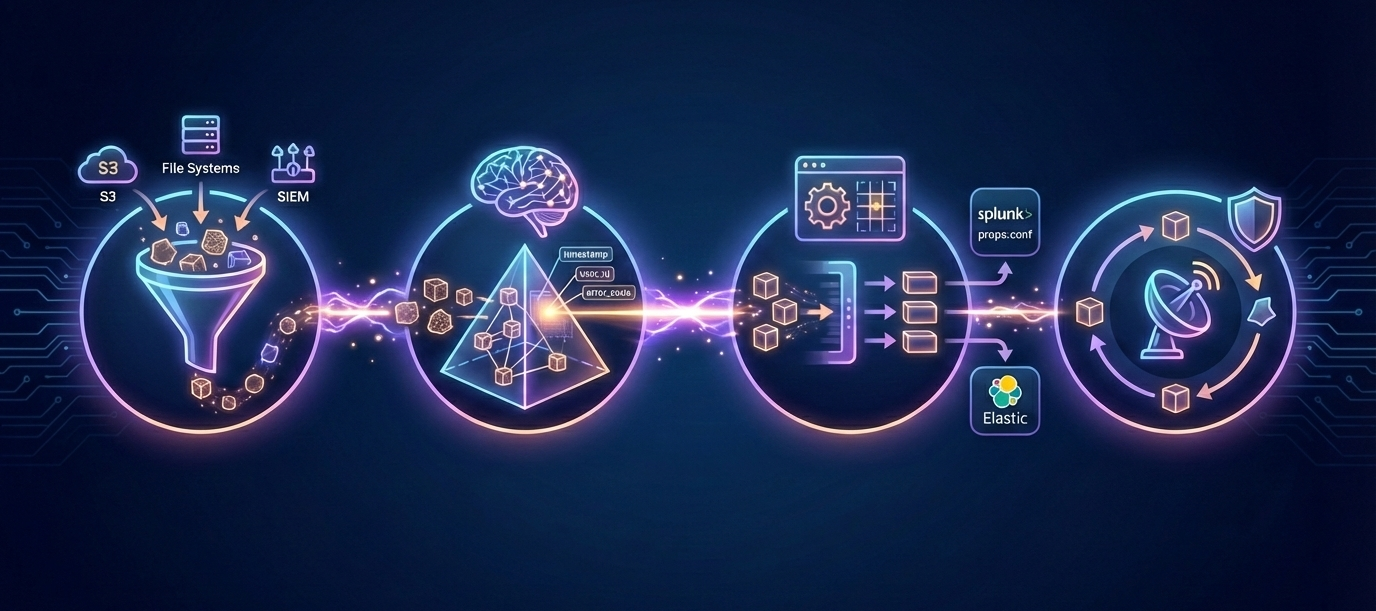
Ingest
Connect to file systems, object storage (S3, Ceph, MinIO), or SIEM platforms. No preprocessing or configuration required.
Learn
AI discovers templates through clustering, extracts fields with named capture groups, and builds a versioned schema catalog.
Normalize
Map fields to standard schemas. Export configurations for Splunk (props.conf), Elastic, and other platforms.
Adapt
Monitor for format changes and maintain backward compatibility. Your analytics stay stable while logs evolve.
Works With Your Stack
Shyft Analyzer integrates seamlessly with existing platforms rather than replacing them
Export & Integration Examples
Auto-generated Splunk configuration
# Auto-generated Splunk props.conf
[source::app_logs]
TRANSFORMS-extract = extract_fields_app_logs

# transforms.conf with AI-learned patterns
[extract_fields_app_logs]
REGEX = (?<timestamp>\d{4}-\d{2}-\d{2}T\d{2}:\d{2}:\d{2}) \
        (?<level>INFO|ERROR|WARN) \
        (?<user>[\w\.]+@[\w\.]+) \
        (?<action>\w+)
FORMAT = timestamp::$1 level::$2 user::$3 action::$4
🛡️ Security Operations
Maintain stable detection rules across log format updates. Ensure threat detection doesn't break when vendors change log structures.
⚙️ DevOps Teams
Manage diverse application and infrastructure logs without maintaining fragile parsers. Onboard new services instantly.
📋 Compliance & Audit
Traceable log structure documentation with full change history. Meet audit requirements with centralized schema governance.
🔄 Platform Migration
Move between SIEM vendors without rewriting parsers or detection rules. Normalized schemas work across any platform.
Stop Breaking When Logs Change
Transform unstructured logs into intelligence-ready data that scales with your rapidly evolving infrastructure.